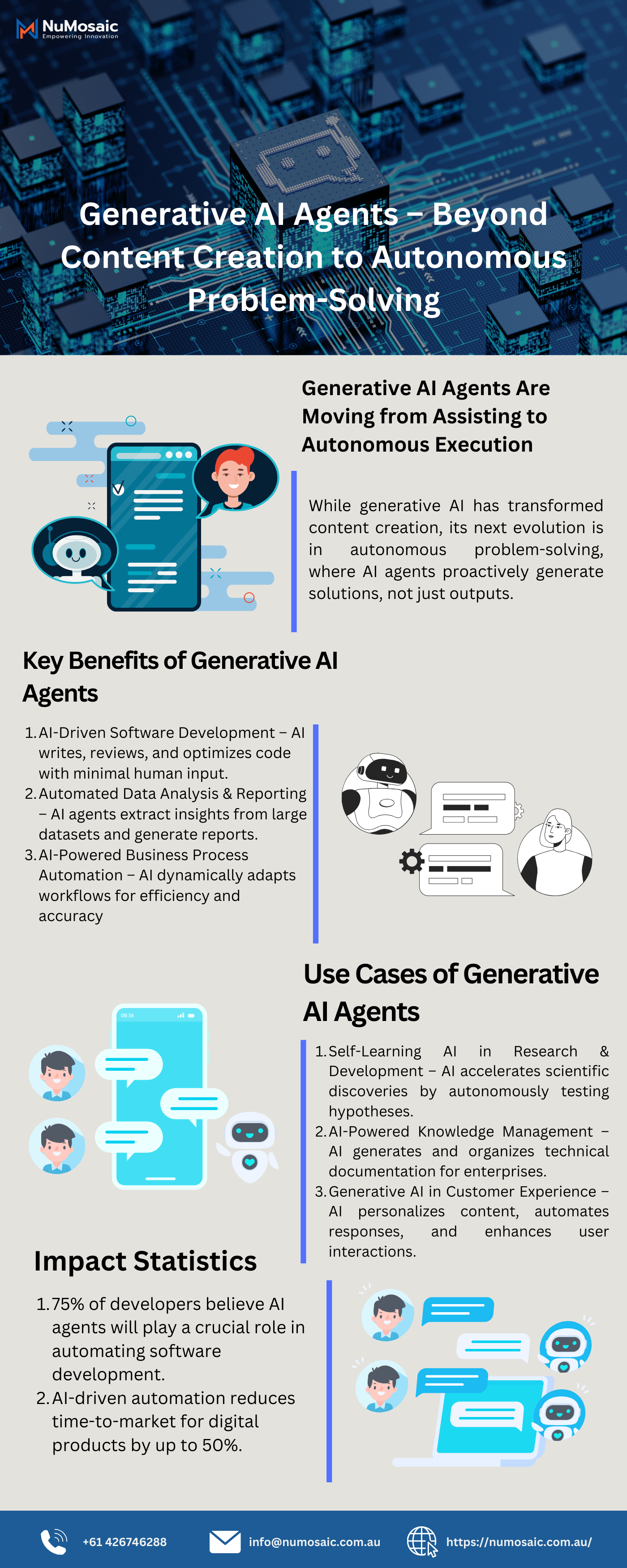

Introduction: The Evolution of Generative AI
Generative AI has rapidly evolved from a tool for content creation into a powerful force for autonomous problem-solving. While early models focused on generating text, images, and media, the next wave of AI agents goes beyond by independently analyzing data, making decisions, and solving complex problems with minimal human intervention.
What Are Generative AI Agents?
Generative AI agents are advanced systems powered by large language models (LLMs) and machine learning algorithms. Unlike traditional AI models that require specific prompts, these agents can:
Interpret Context and Intent: Understand nuanced instructions and execute multi-step tasks.
Autonomously Execute Actions: Perform operations without constant human oversight.
Learn and Adapt: Improve performance through continuous learning and feedback loops.
Key Capabilities of Autonomous AI Agents
Data-Driven Decision-Making:
Process and analyze large datasets in real-time.
Extract insights and recommend actionable strategies.
Predict trends using advanced forecasting models.
Automated Workflows and Task Management:
Handle repetitive or time-consuming processes.
Automate scheduling, reporting, and customer interactions.
Enhance productivity by reducing manual intervention.
Complex Problem-Solving:
Identify inefficiencies and suggest optimized solutions.
Troubleshoot technical issues through real-time diagnostics.
Execute multi-step processes autonomously.
Seamless Integration with Existing Systems:
Connect with CRMs, ERPs, and APIs for smooth operations.
Improve operational efficiency with minimal human oversight.
Industries Benefiting from Autonomous AI Agents
Healthcare:
Accelerate medical research by analyzing clinical data.
Automate patient appointment scheduling and follow-ups.
Finance:
Detect fraud in real time through automated monitoring.
Optimize portfolio management using predictive models.
E-commerce:
Enhance customer support with AI-powered virtual assistants.
Automate order processing and inventory management.
Marketing and Content Creation:
Generate personalized marketing campaigns.
Optimize ad targeting with AI-driven insights.
Benefits of Generative AI Agents in Problem-Solving
Enhanced Efficiency: Streamlines operations by automating routine and complex tasks.
Improved Accuracy: Minimizes human error through precise data processing.
Scalability: Allows businesses to scale without proportional increases in resources.
Data-Backed Insights: Delivers actionable insights for informed decision-making.
Challenges and Considerations
Ethical Concerns: Ensuring transparency, fairness, and data privacy.
Reliability and Bias: Mitigating inaccuracies and algorithmic biases.
Human Oversight: Balancing automation with necessary human intervention.
Conclusion: The Future of Autonomous AI Agents
Generative AI agents are reshaping industries by going beyond content creation into autonomous problem-solving. With their ability to analyze data, automate tasks, and make independent decisions, these agents are driving efficiency and innovation. As AI technology continues to advance, the seamless integration of autonomous agents into business processes will unlock new levels of productivity and growth.