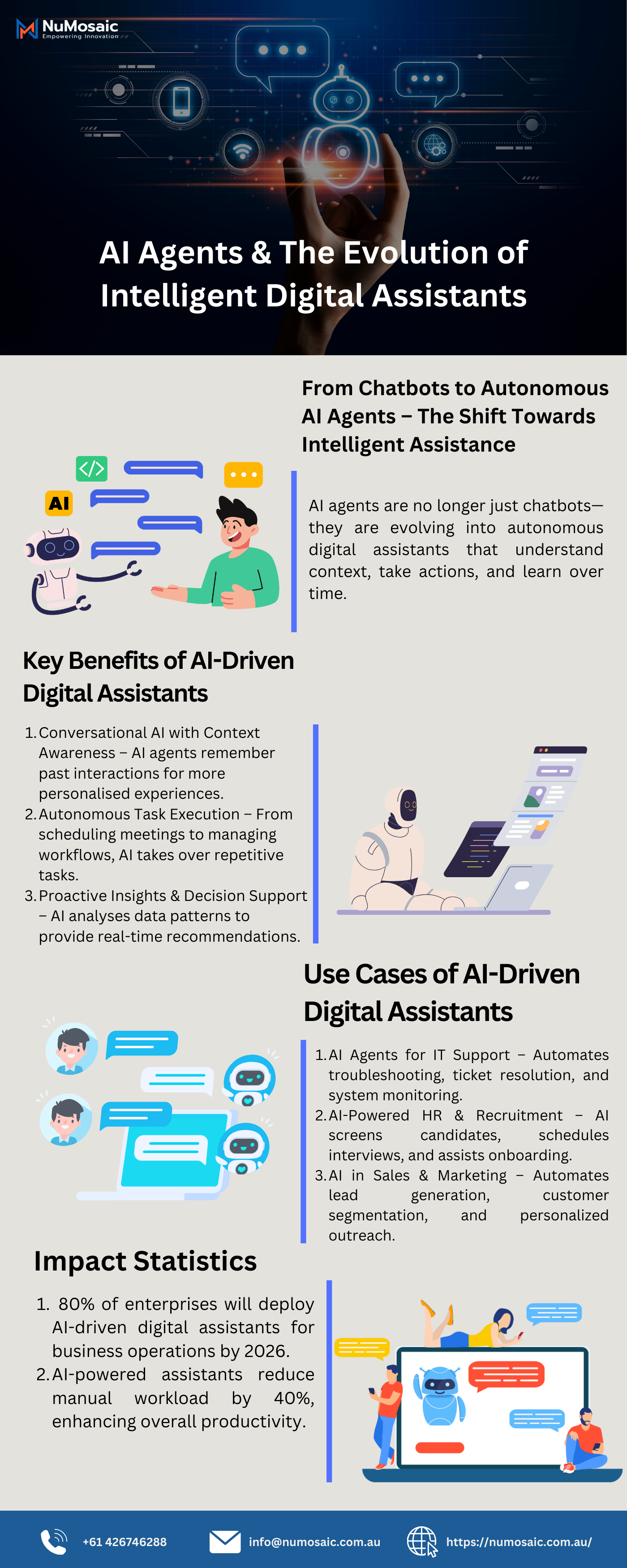

Introduction: The Rise of Intelligent Digital Assistants
AI-powered digital assistants have rapidly evolved from simple task managers into sophisticated autonomous agents. Today, these intelligent systems go beyond basic commands—they interpret context, make decisions, and solve complex problems with minimal human intervention. This evolution is transforming how businesses and individuals operate, driving efficiency and innovation.
What Are AI Agents?
AI agents are advanced autonomous systems powered by machine learning, natural language processing (NLP), and large language models (LLMs). Unlike basic digital assistants, these agents can:
Understand Context and Intent: Interpret nuanced commands and execute multi-step tasks.
Autonomously Take Action: Perform operations with minimal or no human oversight.
Learn and Improve: Adapt and refine their capabilities through data-driven learning.
Key Capabilities of Intelligent AI Agents
Contextual Understanding and Decision-Making:
Analyze data in real-time and make informed decisions.
Interpret natural language for accurate responses.
Execute complex workflows with contextual awareness.
Seamless Task Automation:
Handle repetitive, manual tasks autonomously.
Automate scheduling, data entry, and reporting.
Boost productivity by reducing human intervention.
Enhanced Personalization and Engagement:
Deliver tailored experiences based on user behavior.
Provide personalized recommendations and solutions.
Enhance customer interactions with dynamic responses.
Multi-Platform Integration:
Integrate with CRMs, APIs, and third-party tools.
Streamline business operations through interconnected systems.
Improve efficiency by reducing platform switching.
Industries Leveraging AI Agents
Customer Service:
AI-powered chatbots for real-time, 24/7 support.
Automated ticket resolution and escalation.
Personalized customer experiences.
Healthcare:
Virtual health assistants for patient interactions.
Automated scheduling and follow-ups.
Data-driven diagnostics and insights.
Finance and Banking:
AI agents for fraud detection and prevention.
Automated financial reporting and analysis.
Personalized financial advice and portfolio management.
E-commerce and Retail:
Intelligent product recommendations.
Automated order tracking and customer support.
Inventory and pricing optimization.
Benefits of AI Agents in Digital Transformation
Enhanced Efficiency: Streamline workflows by reducing manual tasks.
Improved Accuracy: Minimize errors with automated data processing.
Scalability: Scale operations without increasing resource demands.
Data-Backed Insights: Generate actionable insights for better decision-making.
24/7 Availability: Provide continuous support and engagement.
Challenges and Considerations
Privacy and Security: Safeguarding sensitive data and preventing breaches.
Bias and Fairness: Ensuring unbiased and ethical AI decision-making.
Reliability and Accuracy: Mitigating errors in autonomous operations.
Human Oversight: Balancing automation with necessary human intervention.
Conclusion: The Future of Intelligent AI Agents
AI agents are transforming digital assistants from basic task executors into autonomous problem-solvers. With their ability to understand context, automate workflows, and deliver personalized experiences, these agents are redefining business efficiency and customer interactions. As AI technology continues to evolve, intelligent digital assistants will become indispensable tools across industries, driving innovation and growth.